
Discover Ravenna
Ravenna is the city of mosaics.
In Ravenna, you can feel Art, History and Culture in every corner.
Recognized worldwide for its historical and artistic treasures, the city preserves the richest heritage of mosaics dating from the 5th and 6th centuries AD within its early Christian and Byzantine religious buildings, included by UNESCO on the World Heritage List.
Walking and cycling through the city centre is like reliving an ancient history: starting from the Roman era and its magnificent early Christian basilicas, through the Renaissance and up to the 19th century, when the city was rediscovered by famous visitors such as Lord Byron, Oscar Wilde, Sigmund Freud and Gustav Klimt.
Ravenna is the city of mosaics. In the past, this ancient cradle of art and culture was three times capital: first of the Western Roman Empire, then of the Reign of Theoderic, King of the Ostrogoths, and finally of the Byzantine Empire.
The historical buildings of Ravenna and especially the eight monuments included in the Unesco World Heritage List are the indelible traces of that glorious past of Ravenna.
Although it did not originate in Ravenna, the art of mosaic has reached its peak in this city. A Latin hexameter on the walls of the Archiepiscopal Chapel reminds us of its splendour: “Aut lux hic nata est aut capta hic libera regnat”, which in translation means “Either light was born here or, if imprisoned here, it reigns free”. Today, this ancient art form is perpetuated thanks to the activity of schools, workshops and numerous events spread throughout the year, such as the biennial RavennaMosaico, the First International Festival of Contemporary Mosaic.
Ravenna is Roman, Goth, Byzantine and Venetian, medieval and contemporary. It is a welcoming place, where cultural events meet prestigious international festivals. The rich programme of Ravenna Festival, the exhibitions of MAR (City Art Museum), its archaeological sites and the events organized every year for poet Dante Alighieri are just some examples of the importance of Ravenna as a new capital of art and culture.
In addition to the extraordinary richness of its architectural heritage, the city’s short distance from the Adriatic coast make it an attractive destination for those seeking relaxation and fun, as well as the ideal place for hiking surrounded by nature.
Ravenna is a sparkling city full of artistic and cultural events, which traditionally welcomes its guests with courtesy and spoils them with tasty dishes, always accompanied by a good wine.
On the coast of Ravenna there are nine seaside resorts, which can provide everything you need for a pleasant and enjoyable holiday.
Marina di Ravenna, with its amazing beaches, the extended pinewood and the Marina, is only 10 km. away.
The young people and the families with children can reach the amazing Mirabilandia Park in 20 minutes by car or bus.
Nearby, the National Museum of Underwater Activities and the area of fish restocking named “Paguro”, destination of scuba divers and researchers, are very interesting.
Even the “Pialassa of the Baiona”, the lagoon part of the Natural Park of the Delta of Po, well worth a visit by boat or bicycle.
From Ravenna it is easy to reach by car/bus all the famous locations on the Adriatic coast, as Cervia, Milano Marittima and the Republic of San Marino.
RAVENNA WORLD CULTURAL HERITAGE
“The early Christian religious monuments in Ravenna are of outstanding significance by virtue of the supreme artistry of the mosaic art that they contain, and also because of the crucial evidence that they provide of artistic and religious relationships and contacts at an important period of European cultural history”.
It’s for this reason that in December 1996 Unesco ratified the inscription of the eight Early Christian monuments of Ravenna in the World Heritage List of Unesco.
From that moment, the Basilica of San Vitale, the Mausoleum of Galla Placidia, the Arian Baptistery and the Baptistery of Neon, the Basilica of Sant’Apollinare Nuovo, the Basilica of Sant’Apollinare in Classe, the Oratory of Sant’Andrea (or Archiepiscopal Chapel) and the Mausoleum of Theoderic have been not only heritage of our city but also of the entire world.
Besides the UNESCO monuments, other interesting artistic and archaeological sites such as the Domus of the Stone Carpets and the Area del Parco Archeologico di Classe (Classe Archaelogical Site) make a valuable contribution to the reconstruction of the history of Ravenna.
During the declining period of the Latin civilization, Ravenna undoubtedly represented the most important political and cultural centre of the Western world.
Traces of more recent times from the Middle Ages to the contemporary age can be equally found in the city.
Some of the most celebrated monuments of these periods are the Tomb of Poet Dante Alighieri, the Brancaleone Fortress (Rocca Brancaleone), the Classense Library (Biblioteca Classense), the Municipal Tower (Torre Civica), as well as the monumental gates of the city.
The cultural offer of Ravenna is abundant and varied. Its wide network of museums and collections includes the MAR – Ravenna Art Museum, regularly organizing high-profile exhibitions and hosting a number of permanent collections; the National Museum, exhibiting a variety of collections and findings from excavations of Roman and Byzantine remains; the Archiepiscopal Museum hosting the Chapel of Sant’Andrea (belonging to the UNESCO Heritage); Tamo Museum – All the adventure of the mosaic, a permanent, interactive and multimedia exhibition dedicated to the art of mosaic in all its aspects, from the Antiquity up to the present; Dante Museum collecting relics related to the cult and fame of the poet and finally the Risorgimento Museum, that bears witness to the followers of Mazzini and Garibaldi in Ravenna.
The great variety of landscapes surrounding Ravenna ranges from farmlands with fruit groves, marshes and canals flanked by typical fishing nets to centuries-old pinewoods overlooking sandy, well-equipped beaches.
Nine unique seaside resorts stretch along its 30-km long coastline.
Its beaches offer a wide range of facilities and leisure activities, such as games, sports and fitness, walks and rides, amusement parks (e.g. Mirabilandia), as well as sunshine, relax and culinary delights.
Finally, nature lovers and hikers will enjoy walking through the oasis of Punte Alberete and its quiet flooded forests sheltering rare bird species, as well as visiting the NatuRa Museum of Sant’Alberto, that borders on the Comacchio Valleys, and the ancient pinewood of San Vitale and Classe, which is part of the nature reserve of the Po Delta Park.
THE BASILICA OF SAN VITALE
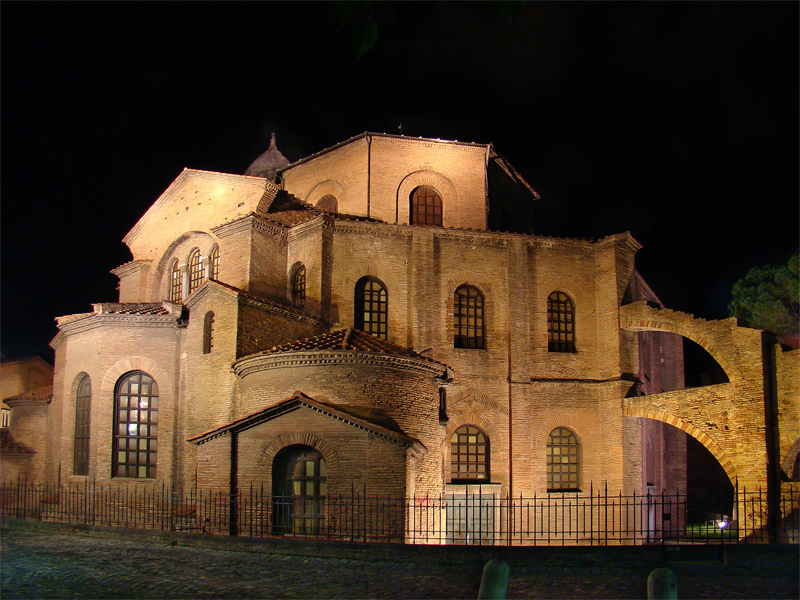
The Basilica of San Vitale – faced with one of our amazing apartments – is a church in Ravenna and one of the most important examples of early Christian Byzantine art and architecture in Europe.
The building is styled an “ecclesiastical basilica” in the Roman Catholic Church, though it is not of architectural basilica form.
It’s one of eight Ravenna structures inscribed on the Unesco World Heritage List and it’s one of the most important monuments of Early Christian art in Italy, especially for the splendour of its mosaics.
Founded by Julianus Argentarius and commissioned by Bishop Ecclesius, the octagonal church was consecrated by Archbishop Maximian in 548.
The influence of oriental art, a typical feature of Ravenna buildings, plays a dominant role both for the architecture of the basilica, where elements of Eastern art merge with Western tradition, and for its mosaic decoration, that expresses the ideology and religious beliefs of the Justinian era.
The typical division into nave and two aisles is replaced here by a central, octagonal plan, topped by a cupola that rests on eight pilasters and arches.
The cupola and the niches were frescoed in 1780 by Bolognese painters Barozzi and Gandolfi and Guarana from Veneto.
On entering the Basilica of San Vitale, the eyes are captured by the elevation and width of spaces, by the stunning mosaic decorations of the apse and by the baroque frescoes of the cupola.
It is probably due to this upward thrust that a small and lesser-known treasure often goes unnoticed: a labyrinth is represented on the floor of the presbytery, right in front of the altar.
Small arrows start at the centre of the labyrinth and lead towards the centre of the basilica, going through a winding path.
In the early years of Christianity, mazes were often the symbol of sin and of a possible purification.
Finding the way out of the maze thus represented an act of rebirth.
Once followed the path of the labyrinth, the eyes may contemplate the altar of San Vitale and some of the most beautiful mosaics of Christendom.
THE MAUSOLEUM OF GALLA PLACIDIA
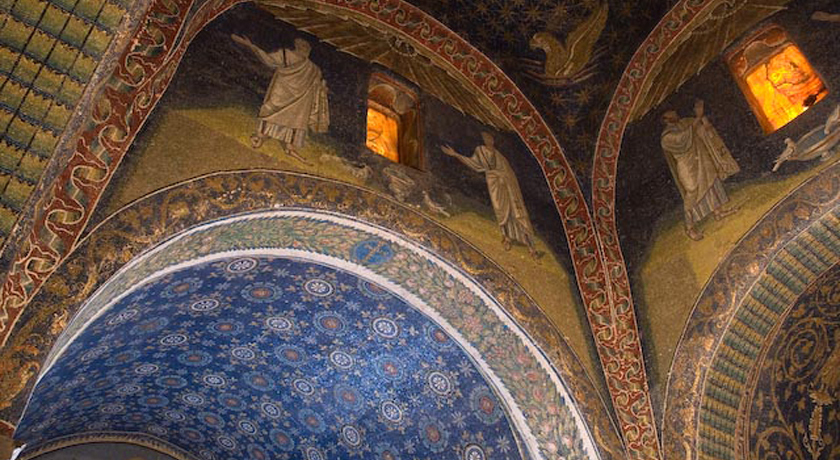
The Mausoleum of Galla Placidia, located just 50 meters from one of our amazing apartments, is a Roman building.
It was listed with seven other structures in Ravenna in the “World Heritage List” in 1996.
The UNESCO experts describe it as “the earliest and best preserved of all mosaic monuments, and at the same time one of the most artistically perfect”.
Galla Placidia (386-452), sister of the Roman Emperor Honorius who had transferred the Capital of the Western Empire from Milan to Ravenna in 402 AD, built this little Mausoleum with a Greek cross plan around 425-450 as her own resting place. However, the mausoleum was never used for that purpose, because the empress died and was buried in Rome in 450.
Now a separate building, the mausoleum was once connected to the south side of the narthex of the close Church of Santa Croce, erected by Galla Placidia between 475 and 500.
The outside of the building is very sober compared to the magnificence of the inside, decorated with mosaics made even brighter by the golden light filtering through the alabaster windows.
The lower surfaces of the interior are covered with marble slabs, while the upper part of the building – including the walls of the vault, the lunettes and the cupola – is entirely decorated with mosaics.
The themes represented in the mosaic decoration show traces of the influence of both Hellenic-Roman and Christian tradition and aim at representing the victory of eternal life over death from different perspectives.
The atmosphere of the Mausoleum of Galla Placidia is undoubtedly magical. The countless stars of the cupola have deeply stirred the imagination of many visitors of Ravenna, for instance Cole Porter who, during his honeymoon in the city, was so impressed by the starry sky of the small mausoleum that he wrote his famous song Night and Day.
THE ARIAN BAPTISTERY
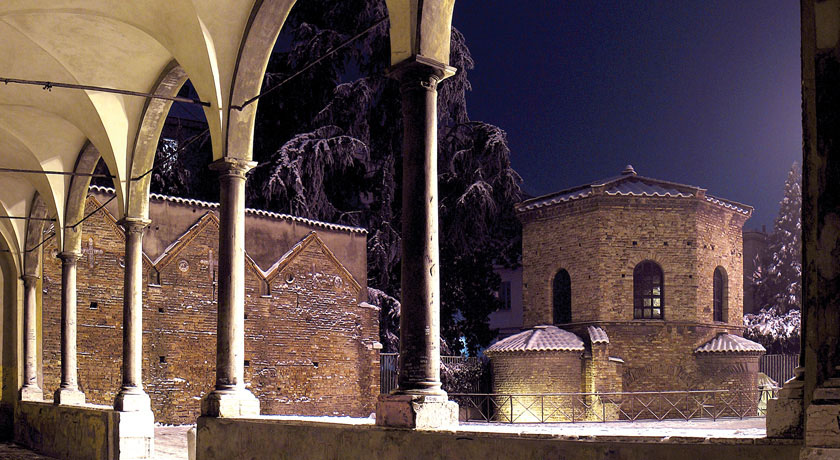
At the end of the 5th Century, when Theoderic had already consolidated his dominion and Arianism had become the official religion of the Court, the Arian Baptistery was built in the small square of the church of the Holy Spirit, the former Arian cathedral.
The building, octagonal in shape and with four small external apses, has sunk about 2.3 metres into the ground. Nothing remains of the various stuccos and decorations which certainly covered the internal walls.
The cupola, instead, is adorned with mosaics depicting the procession of the twelve Apostles and the baptism of Christ, whose naked and young body is immersed in water to the hips.
Although it shows the same iconographical structure of its model, the Baptistery of Neon, the mosaics of the Arian Baptistery are an evidence of the religious beliefs of Theoderic’s court, based on Christ as both an earthly and divine figure.
While in the Orthodox Baptistery the 12 apostles hail the image of Christ on the central medallion as God’s son, in the Arian Baptistery they pay homage to a big throne decorated with gems and topped by a cross, from the arms of which hangs a purple cloth, symbol of Jesus’ corporeity and human suffering.
THE NEONIAN BAPTISTERY
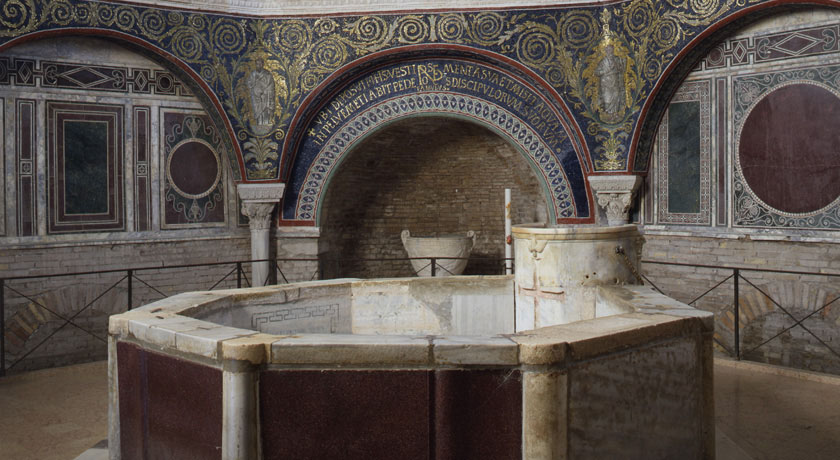
The Neonian Baptistery is one of the most ancient monuments of the city of Ravenna.
It was commissioned by Bishop Urso and probably built at the beginning of the 5th century like the nearby cathedral.
During the episcopacy of Neon (450 – 475), the baptistery underwent many restoration works that ended with the reconstruction of the cupola and the realization of the interior decoration, still present today.
The brick building is octagonal in shape and has four big external niches.
On every side, rounded windows and underground doors open to the inside of the church.
The interior of the baptistery consists of two rows of arches put one above the other.
Its decoration is divided into three tiers, the lower one covered with marble pieces, the middle one with stucco-works, while the upper section is adorned with mosaics of Hellenic-Roman influence.
At the centre of the dome, a big medallion frames the Baptism of Christ, depicted as a young man immersed to the hips in the sheer waters of the river Jordan.
This is one of the oldest mosaic scenes of the Baptism of Christ housed inside a monumental building.
The images of the twelve Apostles, divided into two groups led by Saint Peter and Paul, revolve around the central medallion, standing out against a blue background.
A second ring shows eight exedrae that cover thrones and altars and symbolize the concept of heavenly city and the spread of the Christian doctrine.
In the middle of the building, an octagonal font of Greek marble and porphyry rebuilt in the 16th century still preserves some of its original elements from the 5th century.
In the early 20th century, Carl Gustav Jung, one of the founders of psychoanalysis, was particularly impressed by the magic of these decorations.
THE BASILICA OF SANT’APOLLINARE NUOVO
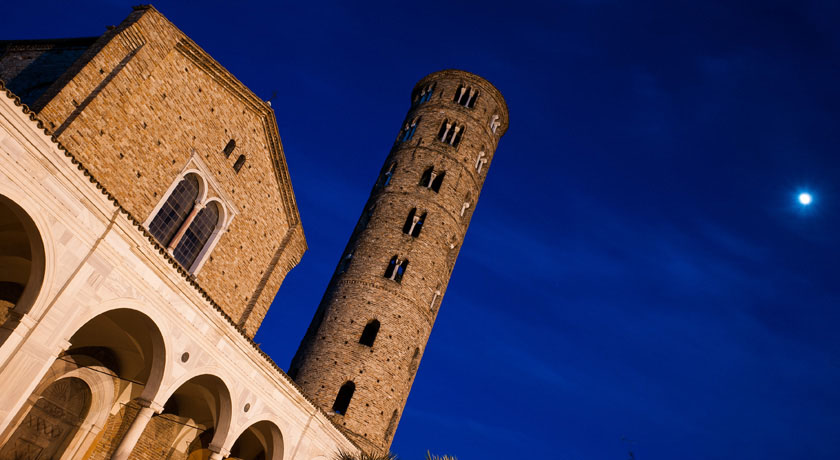
The Basilica of Sant’Apollinare Nuovo, built by Theoderic (493-526) next to his palace, was originally used as a Palatine Church of Arian religion.
After the Byzantine reconquest and consecration to the orthodox faith (mid-6th century), the Basilica was dedicated to St. Martin, bishop of Tours.
Tradition has it that in 9th century the relics of St. Apollinaris were removed from the Basilica of Sant’Apollinare in Classe and transported here. On that occasion, the church was dedicated to Saint Apollinaris and called “Nuovo” (new) in order to differentiate it from the church of the same name in Classe.
The gabled façade of the Basilica is marked by two side pilasters and provided with a mullioned window, topped by two small openings.
Originally, it was probably delimited by a four-sided porch; today it is decorated with a simple but well-balanced 16th-century marble porch.
On the right side of the façade rises a cylindrical bell-tower dating back to the 9th or 10th century.
Inside the building, you can admire the magnificent mosaic decoration of the original church documenting the stylistic, iconographical and ideological evolution of Byzantine wall mosaics from the era of Theoderic to that of Justinian.
The 26 christological scenes from the period of Theoderic are one of the biggest monumental cycles and, at the same time, the most ancient original mosaic work on the New Testament of all times.
THE BASILICA OF SANT’APOLLINARE IN CLASSE
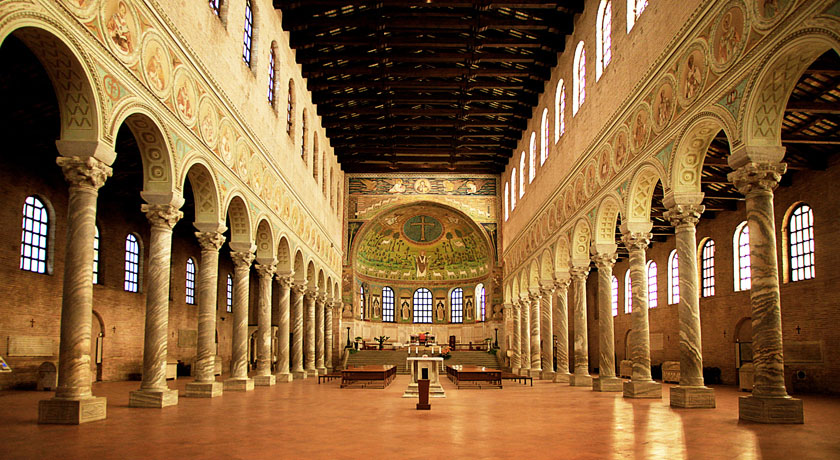
The Basilica of Sant’Apollinare in Classe rises in all its solemn grandeur at a distance of 8 kilometres from the centre of Ravenna.
Commissioned by archbishop Ursicino, the church was built by Julian Argentarius during the first half of the 6th century, on an ancient burial area used in the late 2nd or early 3rd century. Apparently, Saint Apollinaris – one of the first bishops of Ravenna – was buried here.
Sant’Apollinare in Classe has been described as the most impressive basilica of the Early Christian period. Despite the plundering it suffered over the centuries, the basilica has preserved the splendour of its original building. It’s now admired for its beautiful polychrome apse mosaics and ancient marble sarcophagi of archbishops, placed along the aisles.
THE CHAPEL OF SANT’ANDREA

The Chapel of Sant’Andrea or Archiepiscopal Chapel is the only existing archiepiscopal chapel of the early Christian era that has been preserved intact to the present day.
It was erected by bishop Peter II (494-519) during the reign of Theoderic as a private oratory for Catholic bishops when Arianism was the main religion of the court.
Originally dedicated to Christ, the chapel was then renamed and dedicated to Saint Andrew, whose relics were transported from Costantinople to Ravenna around the mid-6th century AD.
The cross-shaped chapel is preceded by a small barrel-vaulted rectangular vestibule, entirely covered with marble in its lower part and decorated with mosaics at the top.
The iconography of the mosaic decoration is of great interest and aims at glorifying the figure of Christ from a clearly anti-Arian point of view.
The representation of Christ as a warrior, his monogram and his face as well as the images of Martyrs, Apostles and Evangelists frequently appear in a dominant position in various places of the chapel, thus underlining the concept of the glorification of Jesus and reaffirming the principles of Catholic orthodoxy.
THE MAUSOLEUM OF THEODERIC
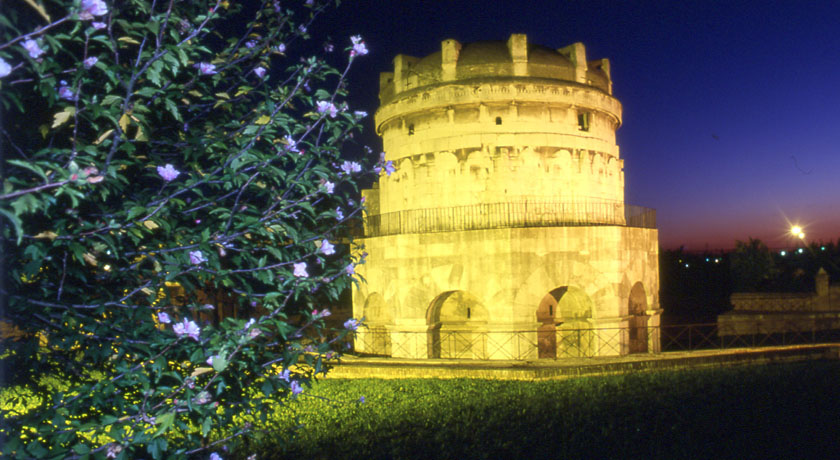
The Mausoleum was built by Theoderic in 520 AD, as his burial place.
Entirely made of Istrian stone, its structure is divided into two decagonal orders placed one on top of the other.
The upper level is topped by a big monolithic dome with twelve square arches bearing the names of eight apostles and four evangelists.
Its dimensions are surprising: it measures 10,76m in diameter and 3,09m in height. According to recent calculations, it weighs 230 tons.
A niche leads to the inferior order which was probably a former cruciform-plan chapel, originally used for religious services. An external staircase leads to the upper floor, that houses a circular porphyry tub where Theoderic was presumably buried.
After Justinian’s edict in 561, during the Byzantine domination, his remains were removed from the Mausoleum that was turned into an orthodox oratory.
MAR – THE ART MUSEUM OF THE CITY OF RAVENNA
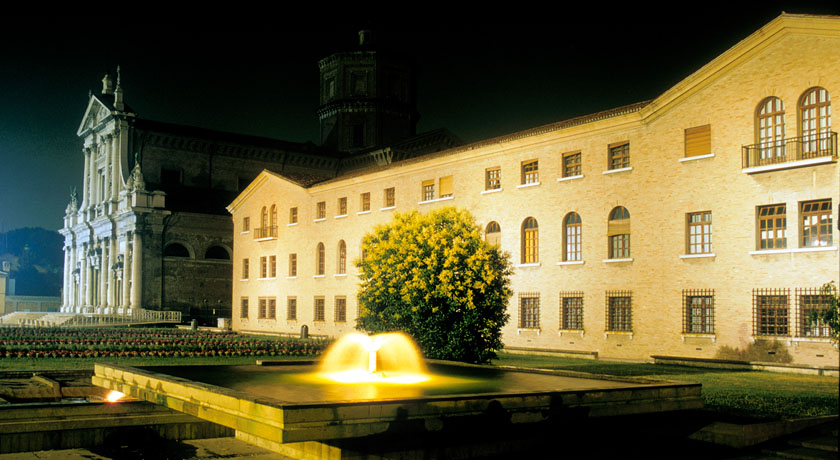
MAR – Museo d’Arte della Città di Ravenna (Ravenna Art Museum) is housed in the monumental site known as Loggetta Lombardesca, a monastery from the 16th century belonging to the near Santa Maria in Porto Abbey.
From Napoleon’s suppressions until the restoration of the early 1970s, the complex underwent frequent reorganisations and changes of use.
Evidences of its original structure are still visible in the Renaissance cloister, in the distribution of space and in the elegant five-arch loggia, symbol and strenght of the whole complex.
Since 2002, the gallery has been an institution of the Municipality of Ravenna.
Its various sections host both important temporary art exhibitions and three permanent collections, namely:
– a collection of ancient artworks, paintings and sculptures from 14th to 19th century, including the outstanding statue of Guidarello Guidarelli by Tullio Lombardi (1525);
– a collection of modern artworks from 19th to 21st century, among which a wonderful drawing by Gustav Klimt;
– a collection of contemporary mosaics, including works carried out between mid-19th century and the present day.
THE DANTE MUSEUM
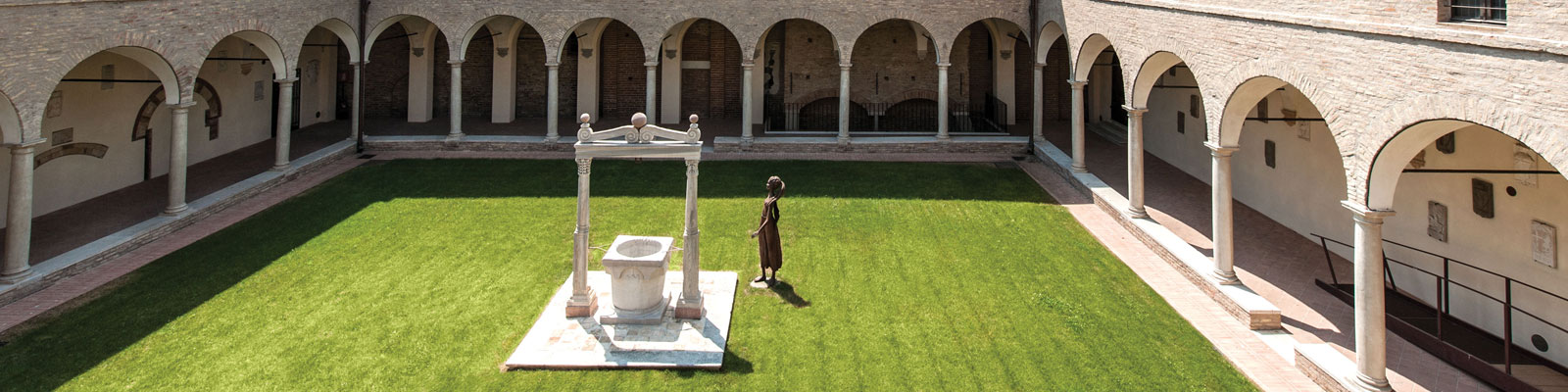
The Dante Museum (Museo Dantesco) – next to one of our apartments in Ravenna – is located inside Centro Dantesco dei Frati Minori (Dante Centre of Friars Minor), in the charming Old Franciscan Cloisters, just a few steps from Dante’s tomb.
Opened on 11th September 1921 during the celebrations for the 6th centenary of Dante Alighieri’s death – occurred in the night between 13th and 14th September 1321 in Ravenna – the museum was projected by architect Ambrogio Annoni (Superintendent of Ravenna at the time) and by the famous and well-educated Corrado Ricci, who had devoted his studies to the works and life of Dante.
The exhibition itinerary aims at highlighting the role played in Dante’s life by the city of Ravenna, where the exiled poet spent his last days. Focus of the exhibition is the iconography of Dante, exemplified by busts, paintings, medals and icons, that raise the issue of his real features on which university researchers have recently developed a new theory.
Moreover, the museum traces back the memories relating to the Tomb and to the well-known issue of the translation of Dante’s bones, that had been concealed for centuries till their chance founding in 1865.
Numerous videos and multimedia products complete the exhibition (among them, a multilingual version of the Divine Comedy), thus meeting the needs of visitors of all ages and nationalities.
THE THEATRE ALIGHIERI
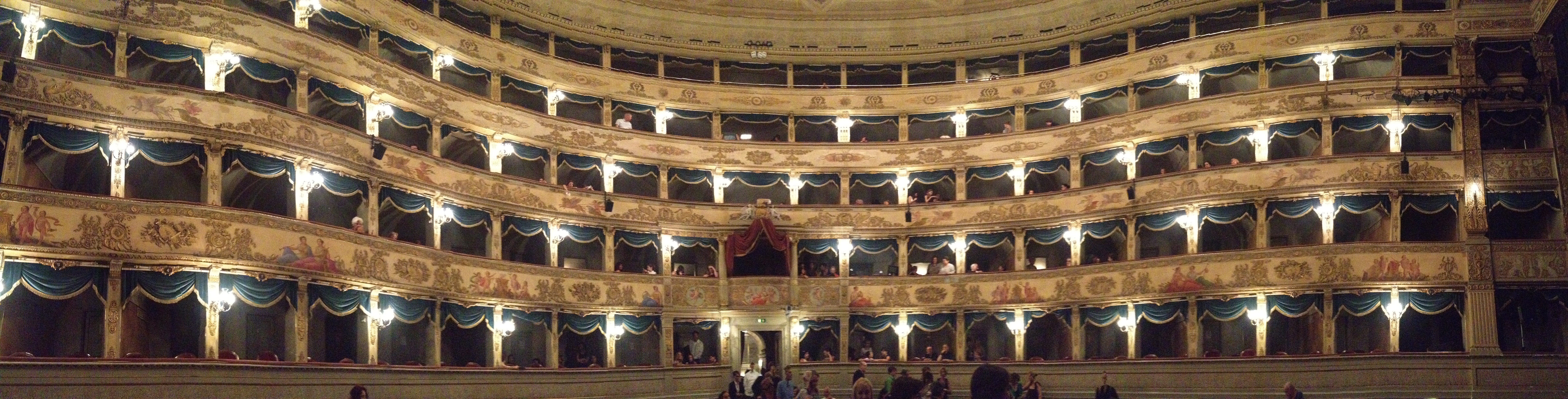
The Teatro Comunale Alighieri is an opera house – next to one of our apartments in Ravenna – designed by the Venetian architects, Tommaso Meduna and his brother, Giambattista, who had designed the second La Fenice theatre after the fire of 1836.
The new Teatro Comunale Alighieri was inaugurated on 15 May 1852 with a production of Meyerbeer’s Robert le diable, followed by Giovanni Pacini’s Medea.
THE DARSENA OF RAVENNA
MARINA DI RAVENNA
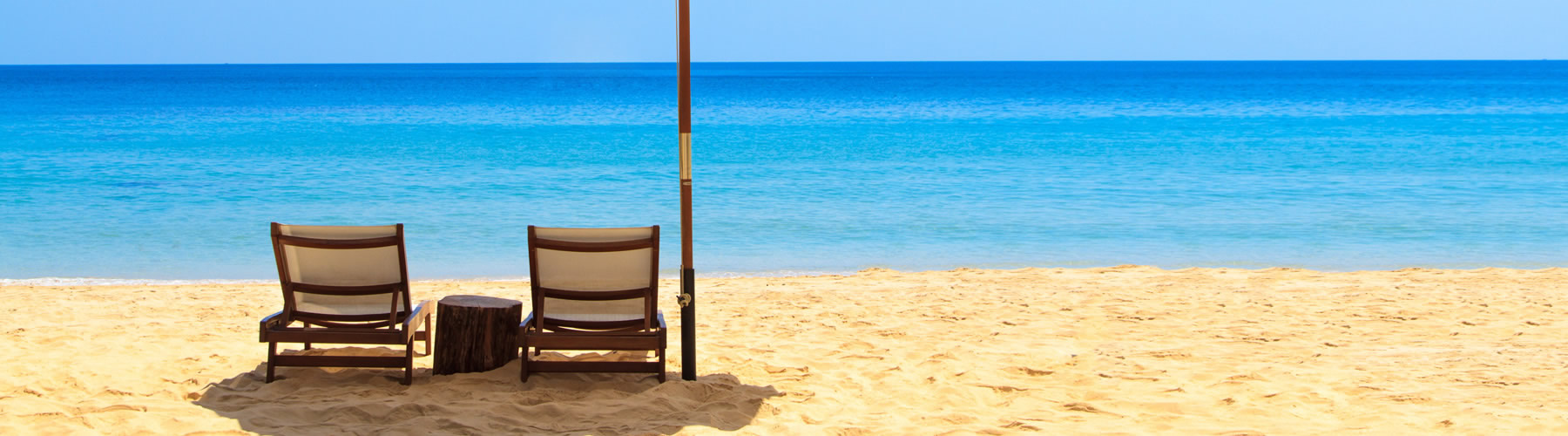
Marina di Ravenna is the ideal destination for the whole family holidays.
The extended pinewood characterizes the landscape and the lifestyle of Marina di Ravenna.
The beach, a long stretch of sand with several equipped beach-clubs, bar and restaurants, is just a few minutes walking from the apartment.
In the surrounding area it’s possible to move comfortably by bicycle, thanks to the many bicycle paths.
During the summer period the town is very lively and entertaining.
Marina di Ravenna offers many beach clubs and restaurants, where it’s possible to enjoy seafood specialties and local cuisine.
The marina can accommodate over 1,500 boats and it is very appreciated by lovers of sailing. On either side of the harbor, it is possible to walk along the dock, which penetrates in the sea waters for almost a kilometer.
Ravenna, the world capital of the mosaic, with its numerous monuments of the Roman and Byzantine period, now a UNESCO World Heritage Site is only 10 km away,
Nearby, the National Museum of Underwater Activities and the area of fish restocking named “Paguro”, destination of scuba divers and researchers, are very interesting.
Even the “Pialassa of the Baiona”, the lagoon part of the Natural Park of the Delta of Po, well worth a visit by boat or bicycle.
The young people and the families with children can reach the amazing Mirabilandia Park in 20 minutes by car or bus.
From Marina di Ravenna it is easy to reach by car/bus some famous locations on the Adriatic coast, as Cervia, Milano Marittima and the Republic of San Marino.